
How to Extract Colour form nature Source
How to Extract Colour form nature Source?
8 posts – 4 participants
https://fstdesk.com/t/how-to-extract-colour-form-nature-source/4714

How to Extract Colour form nature Source
How to Extract Colour form nature Source?
8 posts – 4 participants
https://fstdesk.com/t/how-to-extract-colour-form-nature-source/4714
Waste water treatment plant model
Hello, can someone help me to create a topic how to make a waste water treatment plant model?
2 posts – 2 participants
https://fstdesk.com/t/waste-water-treatment-plant-model/4693
Icing sugar
Can anyone help me for icing sugar
4 posts – 2 participants
Honey Spread
Hi Everybody
I am trying to develop Honey spread, and I am facing stability issue. I observe that the creamy texture is disturbed after I store it in room temperature, as long as it is in the refrigerator the stability is good.
I have been using sucrose ester and citrify in my trials.
Thanks in advance for the help.
6 posts – 3 participants
Disruption of bone and milk
Is it true that milk does bone disruption?
8 posts – 3 participants
Oil and fats adulteration
can any one share detail note onRapid detection of fat adulteration in bakery products using Raman and near- infrared spectroscopies
3 posts – 2 participants
Pulsed Electric Fields for Food Processing Technology
Pulsed electric fields PEF is a non-thermal method of food preservation that uses short pulses of electricity for microbial inactivation and causes minimal detrimental effect on food quality attributes. PEF technology aims to offer consumers high-quality foods. For food quality attributes, PEF technology is considered superior to traditional thermal processing methods because it avoids or greatly reduces detrimental changes in the sensory and physical properties of foods. PEF technology aims to offer consumers high-quality foods. For food quality attributes, PEF technology is considered superior to traditional thermal processing methods because it avoids or greatly reduces detrimental changes in the sensory and physical properties of foods .
PEF technology has been presented as advantageous in comparison to, for instance, heat treatments, because it kills microorganisms while better maintaining the original color, flavor, texture, and nutritional value of the unprocessed food. PEF technology involves the application of pulses of high voltage to liquid or semi-solid foods placed between two electrodes. Most PEF studies have focused on PEF treatments effects on the microbial inactivation in milk, milk products, egg products, juice and other liquid foods . However, whereas a considerable amount of research papers have been published on the microbial aspects of food preservation by PEF, a lesser amount of information is available about the effect of this technology on food constituents and overall quality and acceptability. Recently, the interest in application of pulsed electric fields (PEF) for food processing has revived. The PEF treatment was shown to be very effective for inactivation of microorganisms, increasing the pressing efficiency and enhancing the juice extraction from food plants, and for intensification of the food dehydration and drying , Pulsed electric field technology (PEF) is viewed as one of the most promising nonthermal methods for inactivating microorganisms in foods. Electric fields in the range of 5-50 kV/cm generated by the application of short high voltage pulses (µs) between two electrodes cause microbial inactivation at temperatures below those used in thermal processing. The precise mechanisms by which microorganisms are inactivated by pulsed electric fields are not well understood; however, it is generally accepted that PEF leads to the penneabilization of microbial membranes.
Non-thermal processes have gained importance in recent years due to the increasing demand for foods with a high nutritional value and fresh-like characteristics, representing an alternative to conventional thermal treatments. Pulsed electric fields (PEF) is an emerging technology that has been extensively studied for non-thermal food processing. PEF processing has been studied by a number of researchers across a wide range of liquid foods. Apple and orange juices are among the foods most often treated in PEF studies. The sensory attributes of juices are reported to be well preserved, and the shelf life is extended. Yogurt drinks, apple sauce, and salad dressing have also been shown to retain a fresh-like quality with extended shelf life after processing. Other PEF-processed foods include milk, tomato juice and liquid egg products.
Food preservation technologies are based on the prevention of microbial growth or on the microbial inactivation. In many cases, foods are preserved by inhibiting microbial activity through those factors that most effectively influence the growth and survival of microorganisms such as temperature, water activity, addition of preservatives, pH, and modified atmosphere. In this case, the microorganisms will not be destroyed and will still be metabolically active and viable if transferred to favorable conditions. As estimates of the infection dose of some pathogenic microorganisms are very low, growth of these microorganisms in foods is not necessary to cause infection
To qualify as an alternative method, a new technology should have significant impact on quality while at the same time maintain the cost of technology within feasibility limits. In recent years, several technologies have been investigated that have the capability of inactivating microorganisms at lower temperatures than typically used in conventional heat treatments.
Application of pulsed electric fields of high intensity and duration from microseconds to milliseconds may cause temporary or permanent permeabilization of cell membranes. The effects of PEF on biomembranes have been thoroughly studied since the use of PEF has attracted great interest in several scientific areas such as cell biology, biotechnology, medicine, or food technology.
Read full article.
Pulsed Electric Fields for Food Processing Technology.pdf (1.5 MB)
Research
Maged E.A. Mohamed and Ayman H. Amer Eissa (August 22nd 2012). Pulsed Electric Fields for Food Processing Technology, Structure and Function of Food Engineering, Ayman Amer Eissa, IntechOpen, DOI: 10.5772/48678. Available from: Pulsed Electric Fields for Food Processing Technology | IntechOpen
3 posts – 2 participants
https://fstdesk.com/t/pulsed-electric-fields-for-food-processing-technology/4649
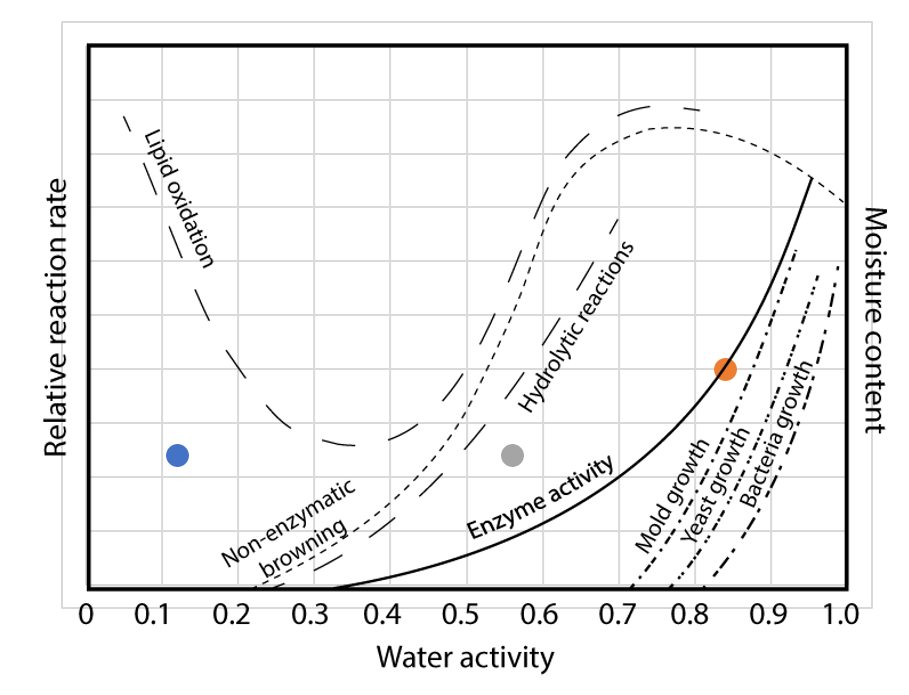
Water activity and Reaction Rates
I have three products with the following water activity & moisture content.
Can you tell which reaction should I be more concerned with for each product?
Please base all answers solely on this graph and disregard the possible effects of product formulation, etc.
Blue – ?
Gray – ?
Orange – ?
3 posts – 3 participants
https://fstdesk.com/t/water-activity-and-reaction-rates/4648
Shortening alternative
I need to use a shortening source with 0 transfat and healthy for children 3 years and above. Butter has Atleast 1 unit trans fat can’t use that.
Can you suggest which I should use?
2 posts – 2 participants
Open Ended Question
Are food scientists/technologists great cooks/chefs as believed?
Discuss?
6 posts – 5 participants

 Food Science & Technology Desk